An international framework,
a personal path.
The language of music is universal. The educational journey is personal.
International music exams provide a framework for assessing a student’s musical development at a given level against structured criteria.
At Bemol, we see these systems not only as an exam goal, but as an international point of reference that supports the student’s development.
02
What are international music exams?
International music exams allow students to demonstrate their musical development at a given level within an independent framework of assessment.
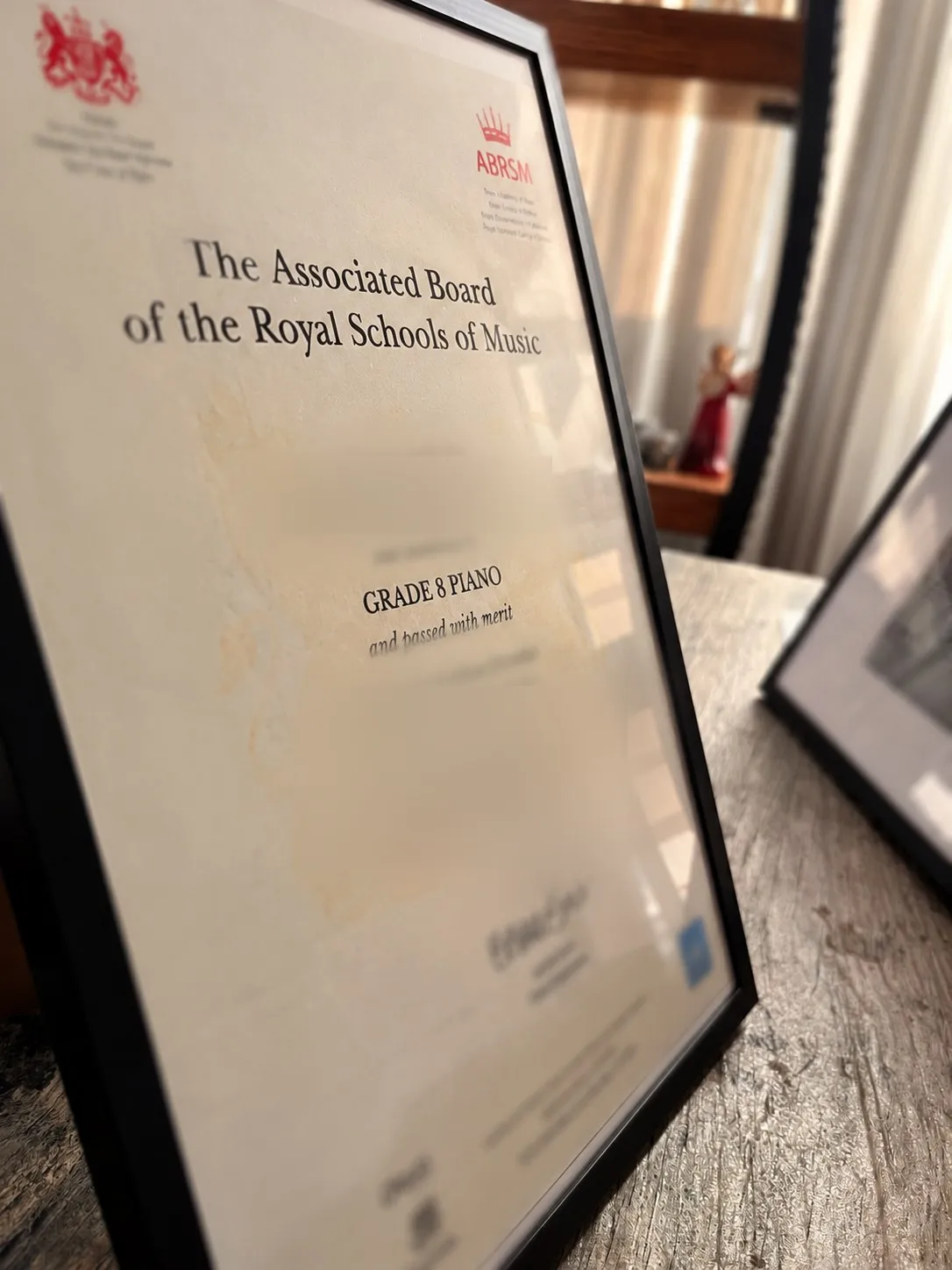
International music organisations such as ABRSM and Trinity offer structured assessment and examination programmes at different levels.
At Bemol, we consider these frameworks in light of each student’s level and goals, and bring them into the learning process when appropriate.
03
An exam is not music itself.
An exam can assess what a student has achieved at a particular level. But music education is a far broader journey than any exam result.
Listening, understanding, developing technique, reading music, interpreting, thinking musically and expressing oneself are parts of that journey that continue well beyond the exam room.
An exam can be a goal. But it is not music education itself.
04
A repertoire is more than an exam.
At Bemol, we do not use Grade repertoire only for students who are preparing to take an exam.
When it suits a student’s level, areas of development and musical journey, we bring pieces from these repertoires into their general piano education.
In this way, even without sitting the exam at that level, students meet a range of technical and musical demands. And if an exam goal emerges later, a structured preparation can be built on the foundation they have already developed.
A Grade is not a label that defines the student; it is one of the resources we use to support their development.

05 — Exam preparation at Bemol
Preparation that deepens with the goal
When an exam goal emerges, we structure the preparation by considering the student’s current development together with the requirements of the chosen exam.
Repertoire, technical work, aural skills, reading and musical expression are then approached within a more focused, goal-oriented practice plan shaped by the student’s needs.
The aim is not simply to complete the exam programme, but to make sure the student genuinely gains the musical skills that level requires.
06
Preparing for an exam is an achievement in itself
Preparing for an exam is about more than the result on the day.
Students learn to work steadily on a repertoire, to prepare for an exam programme, to present what they have learned in a different setting, and to manage their nerves.
An exam result is only one indicator of a student’s musical development. Preparing, taking the exam and living through that experience are part of musical growth too.
An exam result cannot tell the whole story of months of musical growth.
07
When does the exam journey begin?
Music education does not have to begin with an exam.
A student can first build a strong musical foundation. An exam goal can be set at a later stage, in line with the student’s development, level and aims.
It is not necessary to take exams in order or from the very first level. Exam preparation can begin at a level that matches the student’s current development.
08
ABRSM and Trinity
ABRSM and Trinity are two independent organisations in music education and assessment, whose systems are used internationally.
Both offer structured examination and assessment opportunities at different levels. Which framework suits a student can be considered separately, according to their level, goals and educational journey.
At Bemol, we treat these systems not as the single purpose that steers a student’s education, but as an international point of reference and assessment to turn to when it is appropriate.
09
Beyond exams: advanced music education
For some students, their relationship with music may in time grow into a more advanced academic goal.
Conservatoires and advanced music programmes require more than an exam certificate. They call for broader preparation: a strong technical foundation, knowledge of repertoire, aural skills, reading, music theory and musical expression.
For students who wish to move in this direction, education at Bemol can be deepened over time in line with the requirements of the institution and programme they are aiming for.
Goals may change. The foundation does not: a strong musical grounding.

10
Paths that open beyond education
Music education is not limited to a single goal.
International exams can offer a way to assess a student’s development against defined criteria. But a strong musical foundation also opens the way to stage experience, to advanced music education and to the student’s own musical path.
At Bemol, the aim is not to steer students towards a particular outcome, but to give them the musical grounding to choose whichever direction they wish to take.
A shared system. A personal path.
And music, for a lifetime.
We would like
to hear from you.
Tell us about the connection you would like to build with music.
Tell Us →